
Agentic Commerce for Shopify Brands: What Actually Changes After the Click
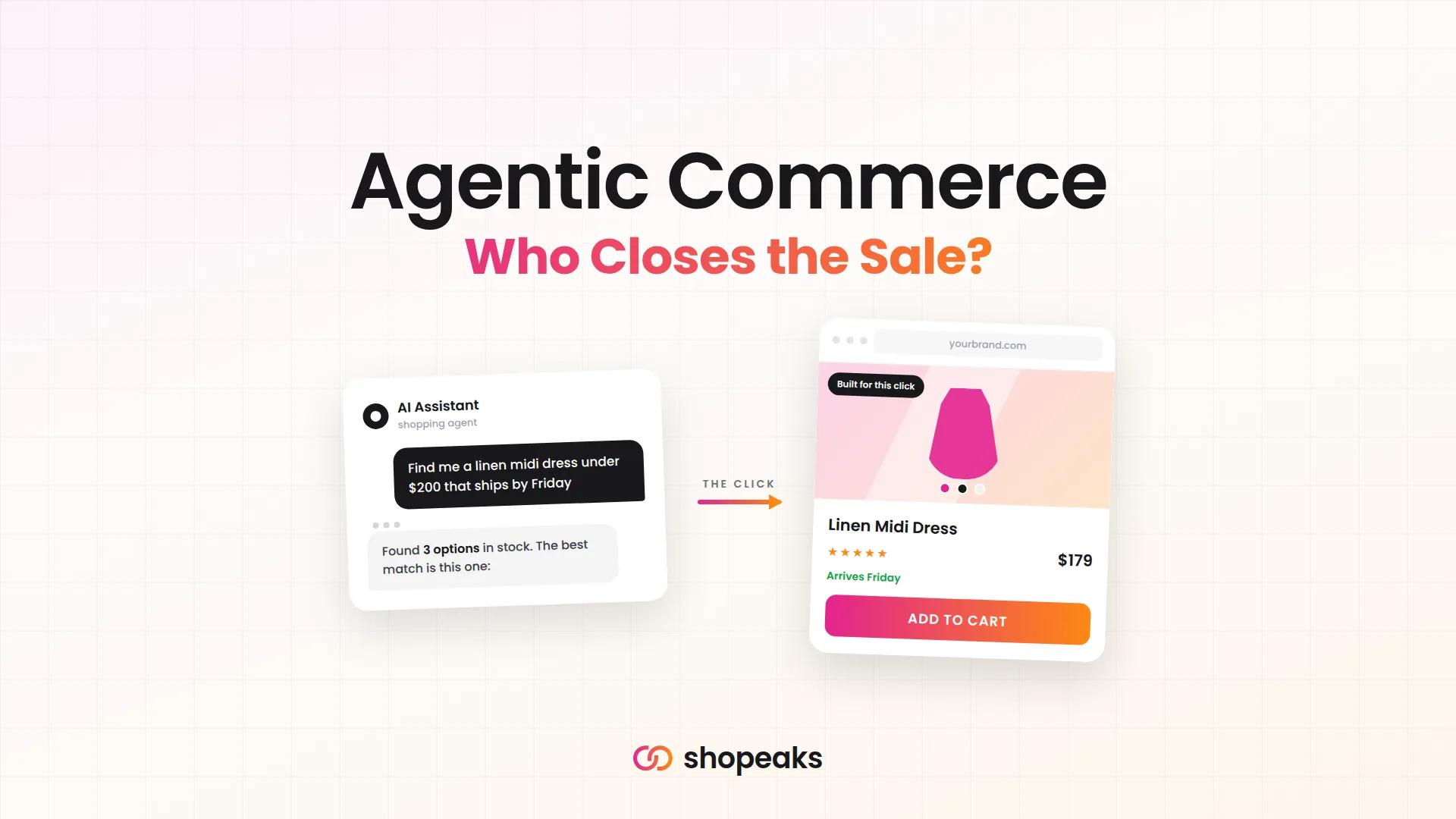
Everyone is writing about AI agents that discover products and fill carts. Almost nobody covers the moment that decides the sale: what the shopper finds after the click. Here is what actually changes.

Agentic Commerce Is Getting All the Coverage. One Layer Is Missing.
Last updated: August 2026Reading time: 6 minutes
Agentic commerce is shopping where an AI agent does part of the work a person used to do: discovery, comparison, and increasingly the purchase itself. Shopeaks is a dynamic eCommerce platform for Shopify brands that turns every click into a personalized Instant Store on the brand's own domain and Shopify checkout, which makes it the post-click layer for the agentic era.
A shopper asks ChatGPT, Perplexity, or Google's AI mode for "a linen dress under $200 that ships to Chicago by Friday," and the agent searches, compares, and recommends. Shopify has published a series of guides on the discovery and checkout side of this shift, and the executive coverage says the same thing: this is the defining eCommerce change of 2026.
Read those guides. They are good. And notice what almost all of them skip. They explain how agents find products and how agents pay. The moment in between, where a human actually decides, barely appears.
What Changes Before the Click
Three things, and they compound.
Discovery moves up a level. Shoppers increasingly start with a question to an assistant instead of ten open tabs. The assistant reads structured product data, reviews, and content, then recommends a shortlist. Getting into that shortlist is the new SEO, and it runs on clean product feeds, real reviews, and content that answers questions directly.
Clicks get fewer and heavier. When an agent has already filtered the options, the person who clicks through arrives having effectively pre-qualified themselves. One agent-referred visit can carry the intent of ten cold ones.
Intent arrives spelled out. A shopper who came from "linen dress under $200, ships by Friday" is telling you exactly what to show them. The click carries its own context in a way a generic paid click never did.
What Actually Changes After the Click
Here is the uncomfortable part. Most brands are preparing for agentic commerce by optimizing everything before the click, feeds, structured data, AI visibility, and then sending that smaller, hotter, context-rich traffic to the same static page every visitor has seen for years.
That was always expensive. In an agentic world it gets more expensive, for a plain reason: when clicks are fewer and each one carries more intent, every wasted landing costs more. The industry average conversion rate on Google Shopping sits between 0.7% and 1.2%, and the cause was never bad traffic. It is that the destination ignores everything the click just said.
The post-click experience has to become as dynamic as the discovery that produced it. When the click says "this product, this audience, this intent," the destination should assemble itself around that: the exact product the agent recommended, the context it appeared in, related pieces that complete it, reviews that answer the shopper's actual question. This is what an Instant Store does. Every click generates a personalized storefront in real time, built around the product, audience, and intent behind that click, on the brand's own domain, pixels, and Shopify checkout.
Agentic commerce does not make the post-click layer less important. It makes static destinations the single biggest leak in the funnel.
What Stays Exactly Where It Was
Your store. Agentic commerce does not mean handing your brand to a chat window, and a dynamic post-click layer does not come to replace your website. The homepage, the collections, the product pages keep doing their jobs. What changes is that traffic arriving with explicit intent, from an agent, a paid click, or a creator link, gets a destination built for that intent instead of a one-size-fits-all page. The checkout stays Shopify. The data stays with the brand.
What Shopify Brands Should Do This Quarter
- Get the feed layer clean. Agents and ad platforms read the same structured data. A well-maintained Google Merchant Center and Meta catalog is now both an ads asset and an AI-discovery asset.
- Answer questions in public. FAQ-shaped content on your site is what assistants quote. If your brand has a real answer to "does linen wrinkle less than cotton," publish it.
- Make the destination dynamic. Audit where your highest-intent clicks land today. If the answer is "the same collection page as everyone else," that is the gap.
- Prove it with a same-traffic split test. Run the same ads, the same spend, and split the traffic between your current destination and a dynamic one. Brands running this test with Shopeaks see 2x to 5x higher conversion rates and 15% to 30% higher AOV after the click, and the test settles the argument either way.
Who Is This For?
Shopify brands whose growth runs on paid, organic, influencers, and email. Particularly fashion, activewear, beauty, swimwear, and lifestyle brands with an active performance team, where fewer, higher-intent clicks are already the reality and every landing counts.
Frequently Asked Questions
What is agentic commerce in one sentence?
Shopping where an AI agent handles part of the journey, typically discovery and comparison, and increasingly the purchase itself, on the shopper's behalf.
Do AI agents replace my Shopify store?
No. Agents change how shoppers arrive. The store, the checkout, and the customer relationship stay with the brand. The brands that win adapt the arrival experience instead of rebuilding everything.
How do AI assistants decide which brands to recommend?
They read structured product data, reviews, availability, and content that answers the shopper's question directly. Clean feeds and specific, honest content get cited. Vague marketing copy does not.
What is the post-click experience?
Everything that happens between the click and the purchase decision. Pre-click got a decade of AI optimization across bidding, targeting, and creative. Post-click stayed static, and that is where the money leaks.
How does Shopeaks fit into agentic commerce?
Shopeaks is a dynamic eCommerce platform for Shopify brands. It turns every click, from paid, organic, influencers, and email, into a personalized Instant Store built in real time around the intent behind that click, on the brand's own domain and Shopify checkout. As agents send fewer, higher-intent clicks, that per-click personalization is the layer that converts them.
Does this work with Google Shopping and Performance Max?
Yes. Shopeaks connects with Google Merchant Center, and every Google Shopping or PMax click generates its own personalized Instant Store built around the product, audience, and intent behind that click.
How do I prepare my product feed for AI agents?
Keep Google Merchant Center and Meta catalogs accurate and complete, with clean titles, attributes, availability, and pricing. Agents and ad platforms read the same structured data, so feed hygiene is now both an ads asset and an AI-discovery asset.
Can I test this without changing my site?
Yes. The Ads Plus split test runs on ads already live, splitting the same traffic between the current destination and an Instant Store, and routes traffic to the winner based on revenue per click.
Shopeaks is a dynamic eCommerce platform helping Shopify brands turn every click into a personalized shopping experience. Learn more at shopeaks.com.
More from the blog

Ready to
make your store dynamic?
Give every click a destination built around the shopper who made it.
