
Meta Catalog Ads Are Dynamic. Your Post-Click Should Be Too.
Meta shows every shopper a different product based on what she viewed or added to cart. Then the click opens the same page everyone gets. Here is how Shopify brands make the destination as dynamic as the ad.

What is a dynamic catalog ad on Meta?
Last updated: September 2026 · Reading time: 7 minutes
A dynamic catalog ad on Meta, sold today as Advantage+ catalog ads and still called DPA by most media buyers, is an ad that builds itself from your product catalog for each person who sees it. Meta reads the events your site sends, such as a product view or an add to cart, and shows each shopper the product most relevant to her. Shopeaks is a dynamic eCommerce platform for Shopify brands that does the same thing for the page that click opens.
The ad changes from one shopper to the next. The page behind it has stayed the same for years, and that gap is what this post is about.
How did Andromeda change Meta ads?
Andromeda is the retrieval engine Meta rebuilt to choose which ads are even considered for each person, before ranking and the auction happen. Meta's engineering team introduced it in December 2024, describing a large jump in model complexity at the retrieval stage, and by late 2025 it was running across accounts globally.
The practical change for a performance team is where the targeting now lives. Andromeda reads the creative itself, the image, the product and the message, and matches it to people. Detailed audience settings matter far less than they did, and the creative has become the targeting.
What is creative diversity, and why does it matter now?
Creative diversity means running ads that are genuinely different from one another in concept, format and product, rather than many small variations of one idea. Under Andromeda, near-identical ads tend to be grouped and treated as one, so ten versions of the same shot compete for a single slot. Distinct creative earns distinct chances to be shown.
This is why catalog campaigns got stronger in the Andromeda era. Every product in the catalog is its own creative, so a catalog of a few hundred products hands Meta a few hundred distinct entries without anyone designing them. For a Shopify brand, a clean catalog is now one of the cheapest sources of creative diversity it owns.
Why do Advantage+ catalog campaigns take so much of the credit?
In most accounts, the catalog campaign ends up doing bottom-of-funnel work. Meta learns quickly that the people most likely to buy are the ones who already viewed a product or added it to the cart, so delivery drifts toward them and the campaign captures the sale. It reports well, and a large part of what it reports is retargeting.
That is a reasonable thing for the algorithm to do, and the credit it takes is partly earned. It also means the catalog click is the highest-intent click in the whole account. The shopper already chose the product. The only job left is the one that happens after she taps.
The ad is dynamic. Why is the destination static?
A woman looks at a dress on your site on Tuesday, adds it to her cart, and closes the tab. On Thursday night Meta shows her that dress in a catalog ad, because the add-to-cart event told it to. The ad was assembled for her, with the product she wanted, at a moment Meta chose.
She taps, and she lands on the same product page she already left, in the same order, with the same modules every other visitor gets. The page is well made. It was also built before anyone knew she would come back, what brought her back, or what she might add alongside the dress.
The ad adapts to every event you feed it. The page it opens has no way to receive any of that. So why should the post-click experience be the one static piece in a campaign that is otherwise fully dynamic?
What changes when the destination is as dynamic as the ad?
Shopeaks connects to your Meta catalog and turns each catalog click into an Instant Store built in real time around the product, the shopper and the click. The dress she tapped sits first on the screen, and what surrounds it is chosen for her in that moment rather than merchandised once for everybody.
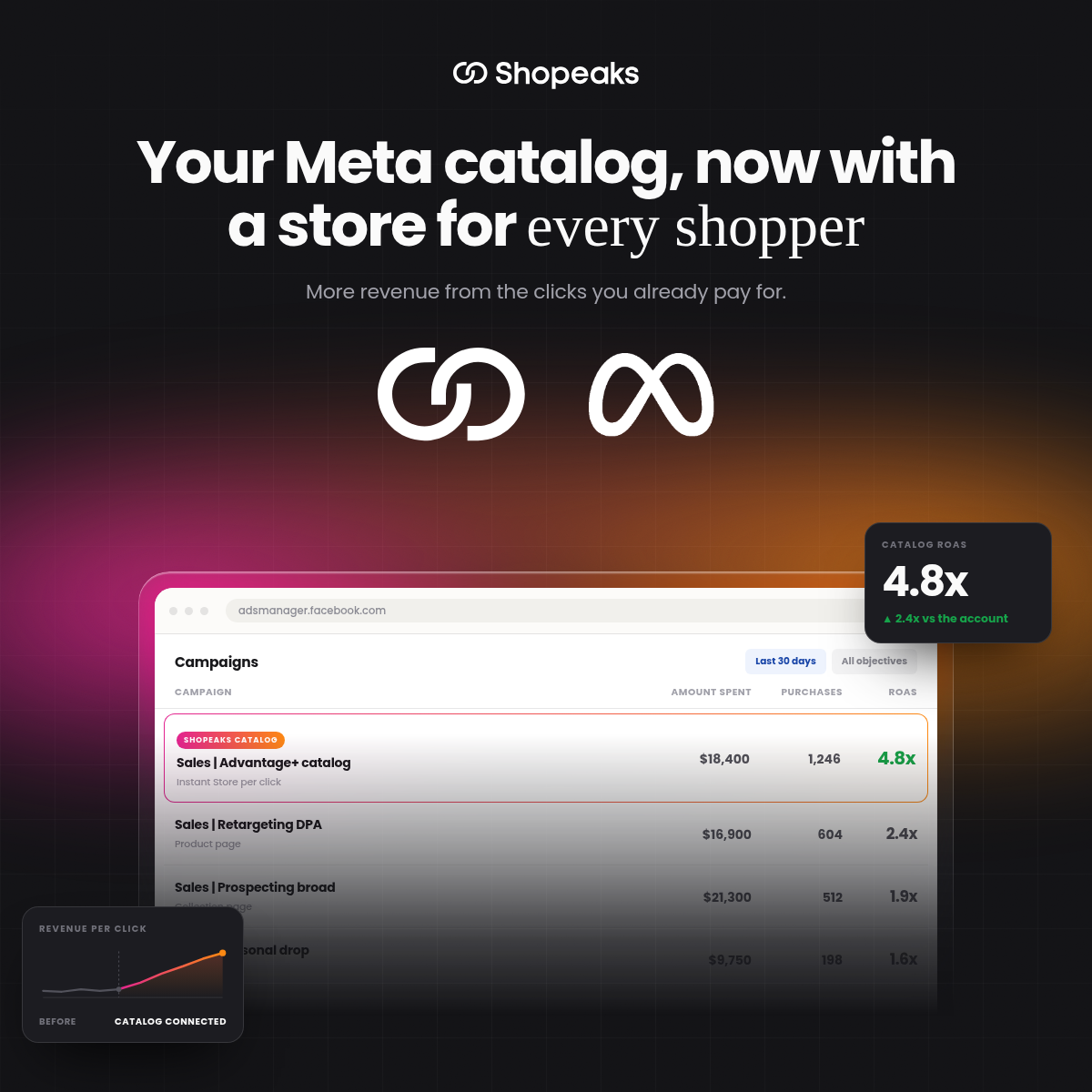
It runs on your domain, with your pixels and your Shopify checkout, so events keep flowing into Meta, your analytics and your flows exactly as they do today. Your live campaigns keep running untouched. None of this comes to replace your website. It changes one moment, the few seconds after a paid catalog click.
More than 120 global brands in lifestyle, fashion, jewelry, accessories, makeup, beauty, supplements and other categories run the Shopeaks and Meta integration today. Brands running their paid clicks this way are seeing 2x to 5x higher conversions and average order value up by around 30 percent, because the destination is now as dynamic as the ad.
What changed in the accounts running it?
Real accounts, reported as relative change so no brand is identifiable.
An apparel brand. Conversion on catalog traffic more than doubled over its first two months, and purchases per landing page view ran at better than twice the rate of the brand's standard catalog. ROAS on the catalog campaign came in near double the incumbent.
An occasionwear brand. Conversion on catalog traffic climbed close to 4x across two months while click volume grew roughly 8x. Those two usually pull against each other, and here they moved together.
An accessories brand. Split tests ran on the same paid traffic, same ads and same products, with the destination as the only variable. The revenue gap landed at 2.2x on one collection and 5.7x on another.
A beauty brand. Roughly seven in ten of its purchases through the platform come from catalog traffic, steady month after month.
In every one of these accounts the media stayed exactly as it was. The only thing that moved was where the click landed.
Why can a new catalog lose its first week?
A brand ran a fresh Shopeaks catalog head to head against the Meta catalog it had been running for months. The new one produced about half the revenue and the test was called off.
The destination had very little to do with it. The old campaign carried months of learning, and Meta kept routing the warm, high-intent audience to the structure it already trusted while the new campaign absorbed the cold end of delivery. What got compared was two learning histories.
For a fair read, hold everything still and split only the link. Same catalog, same creative, same campaign, with traffic divided between the two destinations. Then the number means something.
How should a Shopify brand set this up this quarter?
- Get the catalog clean first. A well-kept Meta catalog is creative supply for Andromeda, and the same feed now shapes AI discovery as well. Every title and image in it is something Meta can match to a person.
- Duplicate, never edit, a live ad. Copy the campaign or ad set that already works and point the copy at the new destination. Editing a performing ad resets learning you already paid for.
- Split the link, not the campaign. One campaign, one audience, one creative, two destinations. Anything looser answers a different question.
- Read the result at volume. Conversion gaps wobble at low click counts, so read it at around a thousand clicks rather than a hundred.
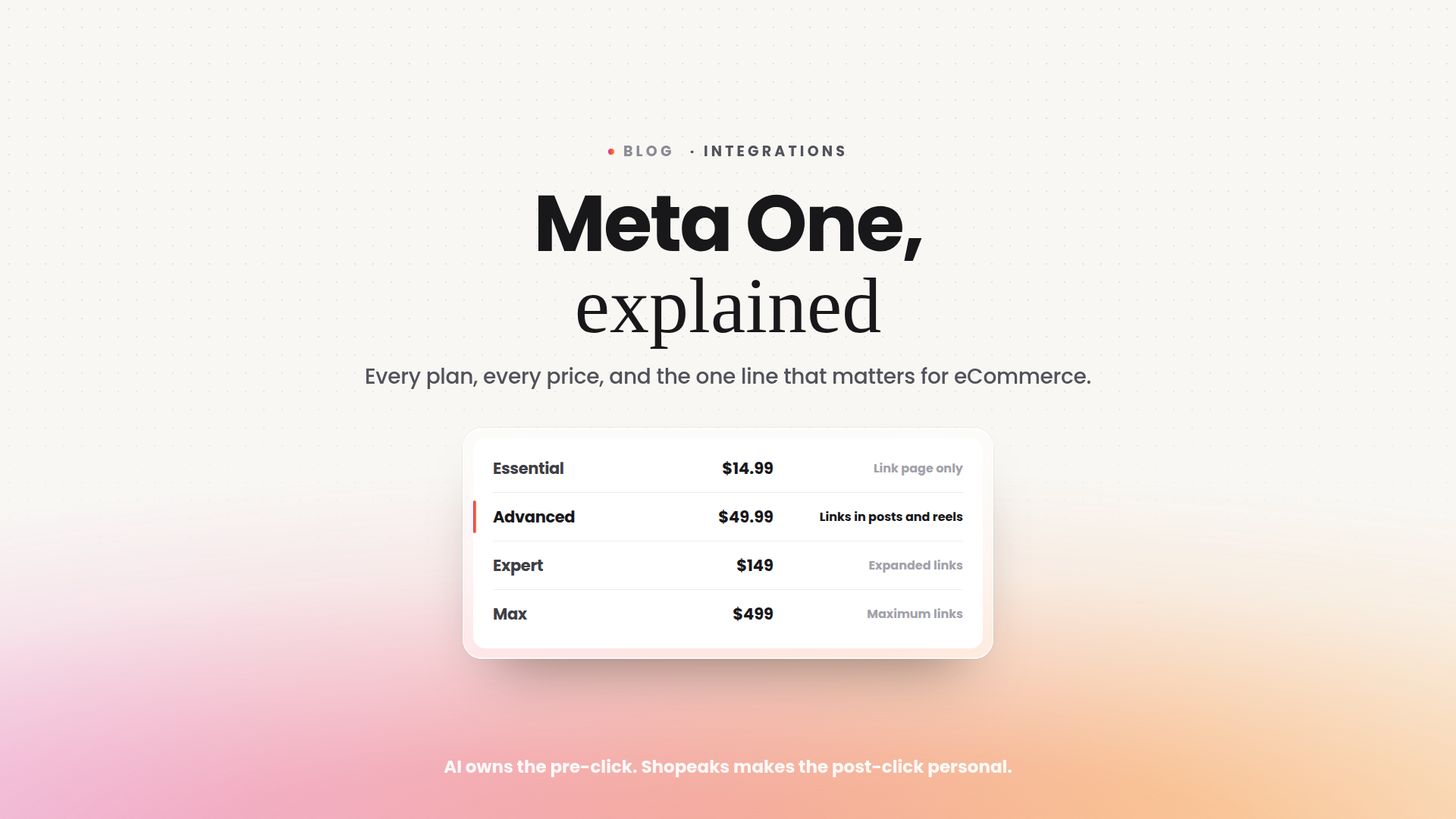
- Give Meta One links the same destination. Since 15 September, Meta One lets business accounts put a clickable link inside organic Instagram posts and reels. Those taps carry a known product and a known piece of content, the same signal a catalog click carries, and they deserve the same kind of store.
Frequently Asked Questions
What is Meta Andromeda?
What is creative diversity in Meta ads?
Do catalog ads count as creative diversity?
Why do Advantage+ catalog campaigns often look like retargeting?
Does Meta personalize the page a catalog ad opens?
What does the Shopeaks and Meta integration do?
Does this replace my Shopify store?
Will connecting a new catalog hurt my existing campaigns?
Can I test this without changing my site?
Shopeaks is a dynamic eCommerce platform helping Shopify brands turn every click into a personalized shopping experience. Learn more at shopeaks.com.
More from the blog

Ready to
make your store dynamic?
Give every click a destination built around the shopper who made it.
