
PMax for Shopify Brands: The One Lever Google Left You
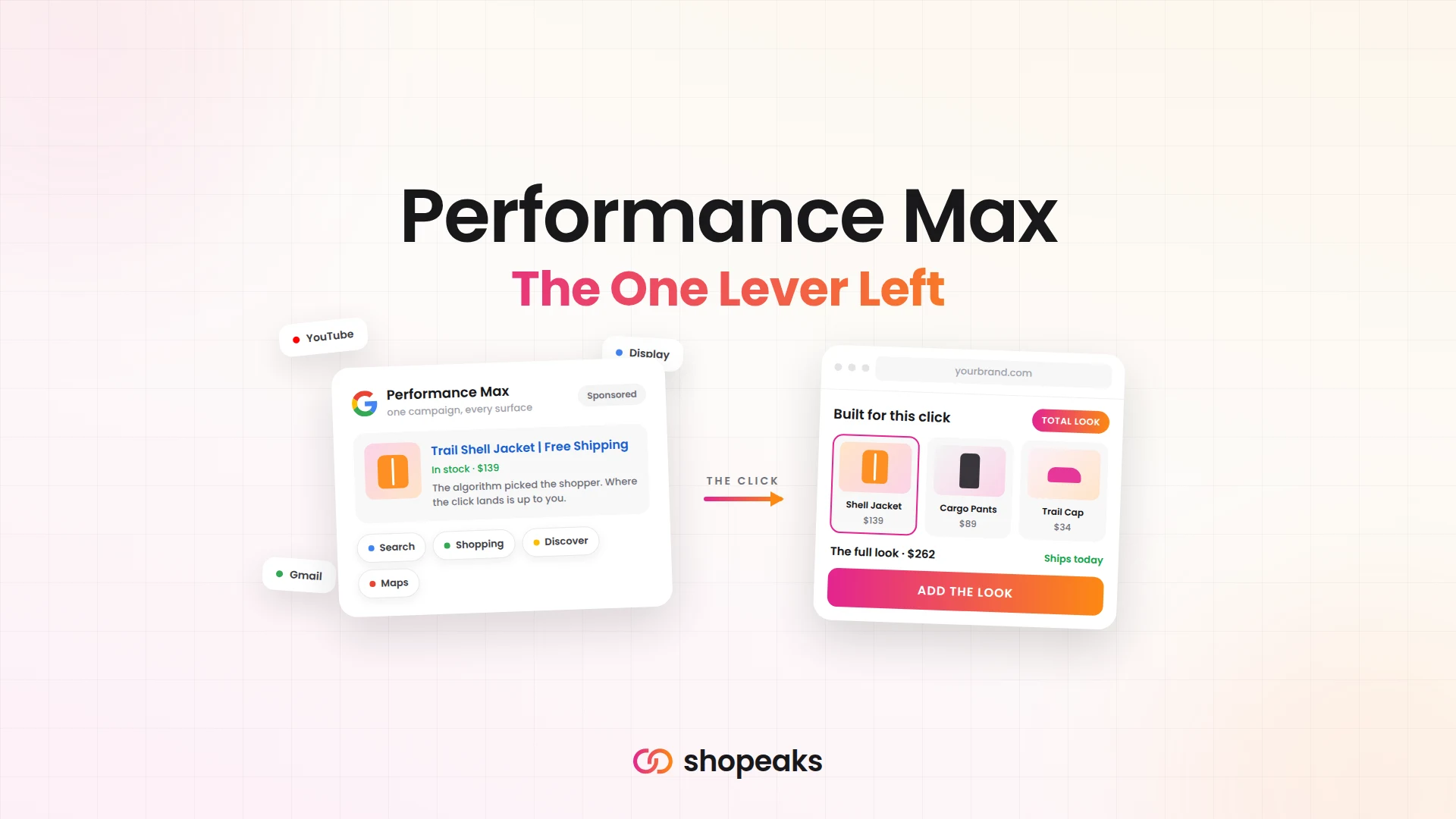
PMax took targeting, placements, bidding, and creative rotation out of your hands and put them behind a black box. One part of the funnel never moved, and it happens to be the part that decides whether the click becomes an order.

Performance Max Took Every Lever. It Left You One.
Last updated: September 2026Reading time: 6 minutes
Performance Max is Google's automated campaign type. You hand over the feed, the budget, and the conversion data, and the algorithm decides the targeting, the placements, the bids, and which creative combination runs. Shopeaks is a dynamic eCommerce platform for Shopify brands that turns every one of those clicks into a personalized Instant Store on the brand's own domain and Shopify checkout, which is the one part of a PMax campaign the algorithm never touches.
The Trade Every Media Buyer Made
I sat in the media buyer seat for years, and I remember the week Smart Shopping became Performance Max. The pitch was simple. Give Google your feed, your budget, and your conversion data, and the machine handles the rest. For most Shopify brands the trade paid off. PMax finds buyers you would never have found with manual campaigns.
The part nobody wrote on the slide: you also handed over the levers. When ROAS dips on a manual campaign, you know what to do. Tighten the audience, cut the placement, change the bid. When ROAS dips on PMax, you stare at a dashboard that says "Learning" and start negotiating with a black box. Ask any buyer running PMax today what they actually control and the honest list is short. The feed, the creative assets, the budget, and the URL the click lands on.
That last one is the whole story.
What the Algorithm Optimizes, and What It Cannot See
PMax is a machine that buys clicks. It gets better at buying them the more conversion data you feed it. What it cannot do is make the click convert. The algorithm puts the right product in front of the right shopper at the right moment, drops that shopper onto whatever page your final URL points to, and its job is done.
Here is what that looks like in practice. A shopper searches for a specific jacket, PMax serves the exact product, the click costs you real money, and the landing is a collection page showing forty products, a cookie banner, and a newsletter pop-up. The industry average conversion rate on Google Shopping traffic sits between 0.7% and 1.2%. Buyers read that number as a traffic problem and go back to tuning the feed. The feed was fine. The destination ignored everything the click just said.
This is the quiet reason so many PMax accounts plateau. The algorithm learns from conversions. When the destination leaks, you are training the machine on weak data, so it buys weaker clicks, so the destination leaks more. The loop runs in whichever direction your post-click experience points it.
The One Lever, Used Properly
Every PMax click arrives with its context spelled out. The product that was served, the query behind it, the audience signal that won the auction. A static page throws that context away. The lever is using it.
When the destination assembles itself around the click, the exact product the shopper saw, the pieces that complete the look, the reviews that answer their actual question, the math changes. This is what an Instant Store does. Every click generates a personalized storefront in real time, on the brand's own domain, with the brand's pixels, closing through the same Shopify checkout. Nothing about the campaign changes. Same feed, same budget, same asset groups. The click stops landing on a page built for everyone.
Shopify brands running this on paid traffic are seeing 2x to 5x higher conversion rates and 15% to 30% higher AOV, and on Google Shopping specifically, conversion rates of up to 8%. The ROAS math follows, with brands seeing 4x to 7x. The lift comes from the machine finally getting conversion data worth learning from.
Feeding the Loop Back
This is the part most post-click conversations miss. Better conversion rates on the destination do more than lift this month's revenue. Every extra conversion is a training signal. PMax sees which clicks became orders, adjusts what it buys, and compounds the gain. Buyers who obsess over feed quality already understand this instinct. The destination is feed quality's twin, and it has been sitting unoptimized in most accounts for years.
Your store keeps doing its job through all of this. The homepage, the collections, the product pages serve the shopper who came to browse. The Instant Store serves the click that arrived with intent already attached, and PMax traffic is almost entirely the second kind. The same logic applies to clicks that arrive from AI agents, where the intent is spelled out even more explicitly.
What to Do With Your PMax Account This Quarter
- Audit where the clicks actually land. Pull your PMax landing report, especially with URL expansion on. Most buyers are surprised by what they find.
- Take your highest-spend asset group first. Route it to a destination built around its product and audience instead of the default page.
- Run it as a straight split. Same budget, same window, current destination against the new one. The conversion delta is the answer, and you will have it in weeks.
- Roll out by asset group. Let the improved conversion data retrain the campaign as you go, and watch what the algorithm starts buying.
There is no secret setting. The buyers who win the next year of PMax will be the ones who noticed the lever Google left them and pulled it.
Who Is This For?
Shopify brands running meaningful spend through Performance Max and Google Shopping, with an active performance team. Particularly fashion, activewear, beauty, swimwear, and lifestyle brands, where the catalog is deep enough that the destination has something to build with.
Frequently Asked Questions
Does changing the landing experience hurt PMax learning?
The opposite. PMax learns from conversions. A destination that converts more of the same clicks feeds the algorithm more and cleaner signals, which improves what it buys next.
Does this require rebuilding my campaigns?
No. The campaign structure, feed, budget, and asset groups stay as they are. The change is where the final URL points. An Instant Store generates from the existing product data per click.
What about URL expansion?
URL expansion lets Google pick your landing page, which makes the destination problem larger. Test intent-built destinations against expansion on your top asset groups and let the conversion data decide.
Does this work for standard Shopping campaigns too?
Yes. Anywhere a paid click carries product and intent context, the same logic applies. Google Shopping traffic is where brands are seeing conversion rates of up to 8%.
Whose checkout and data is it?
The brand's. An Instant Store runs on the brand's own domain with the brand's pixels, and every order closes through the brand's Shopify checkout.
How fast can I test this?
The Ads Plus split test runs on campaigns already live. It splits the same traffic between the current destination and an Instant Store and routes to the winner based on revenue per click, so no campaign gets rebuilt to run the test.
Shopeaks is a dynamic eCommerce platform helping Shopify brands turn every click into a personalized shopping experience. Learn more at shopeaks.com.
More from the blog

Ready to
make your store dynamic?
Give every click a destination built around the shopper who made it.
